7-minute read that could save you $10,000 in denied claims.
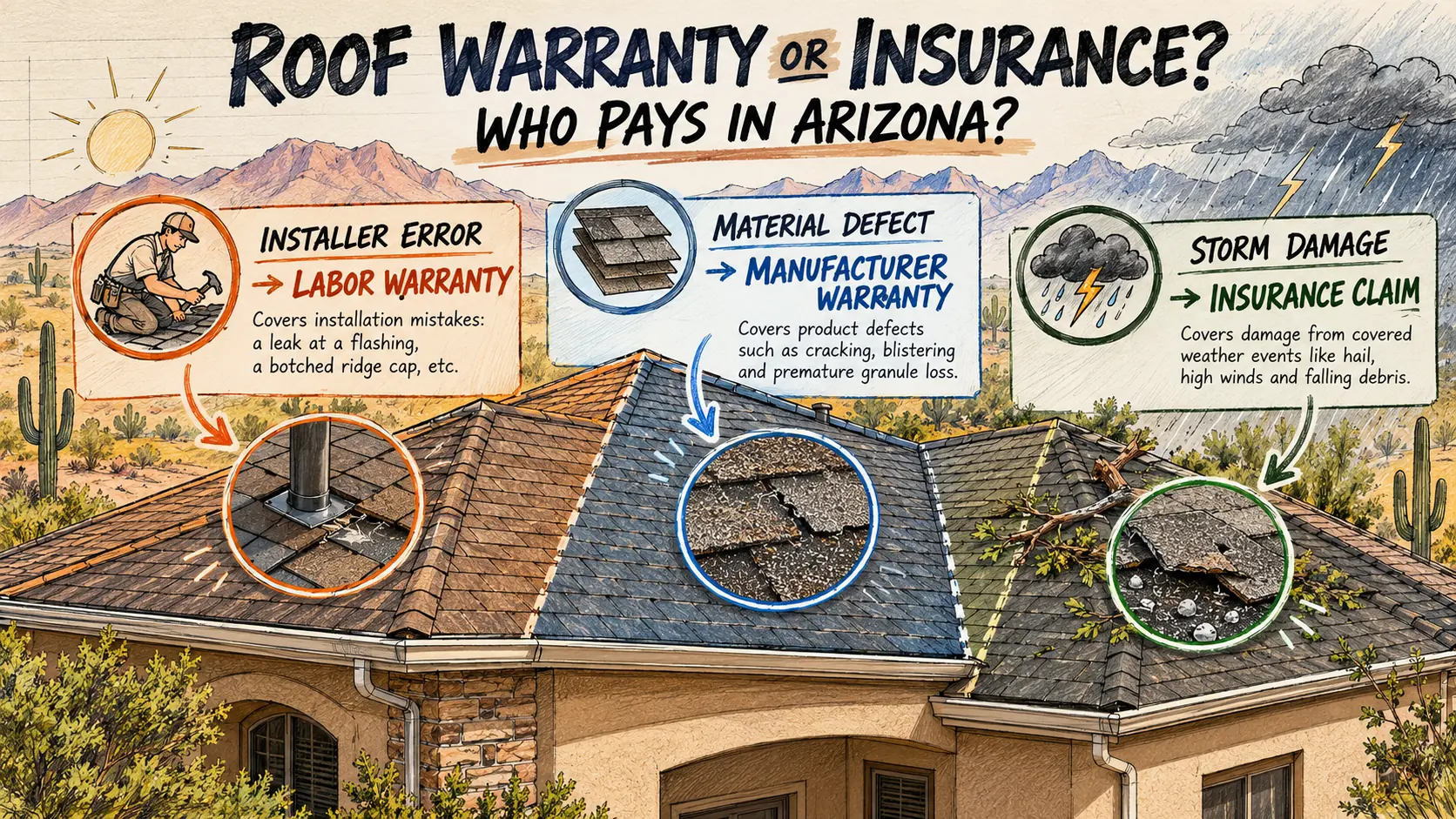
A shingle roof carries two separate warranties, and they cover opposite things. Your labor warranty comes from the contractor and covers installation mistakes: a leak at a flashing, a botched ridge cap. Your manufacturer warranty comes from the shingle maker and covers product defects such as cracking, blistering and premature granule loss.
Google rating
Projects completed
Years in Arizona
They're issued by different people, and they fail differently
Two warranties, two companies, and you in the middle when they point at each other.
The labor warranty is only as good as the company standing behind it. The manufacturer warranty is only as good as the installation underneath it. That entanglement matters more than most homeowners realize — a manufacturer can deny a material claim on the grounds that the shingle failed because it was installed wrong.
The two warranties, side by side
| Labor (workmanship) | Manufacturer | |
|---|---|---|
| Who issues it | Your roofing contractor | The shingle manufacturer |
| What it covers | Installation errors | Material defects |
| Typical term | 5–20 years | Varies by product and tier |
| Prorated? | No — a leak is a leak | Usually, after an initial period |
| Transferable? | Depends on the contractor | Usually once, within a strict window |
| Who you call | Your installer, directly | Your installer, who coordinates |
| What voids it | Unauthorized repairs by another trade | Bad installation, poor ventilation |
Full comparison. Scroll sideways on mobile.
You have two separate warranties from two separate companies, and each can blame the other when something goes wrong.
Something happened to your roof. Who pays?
Pick what happened. We’ll tell you which warranty is on the hook — and which one isn’t.
Roof warranty diagnostic
What happened to your roof?
Pick what happened. We will tell you which warranty is on the hook, and which one is not.
Who pays, by failure type
| What happened | Who pays | Why |
|---|---|---|
| Leak at a flashing or valley | Your contractor | This is workmanship, full stop. Flashings are where roofs leak, and a leaking flashing means it was detailed wrong. Call your installer: no deductible, no proration. |
| Ridge cap or vent installed wrong | Your contractor | Installation error. Also the kind of defect that voids the manufacturer warranty if it is left alone, so it is worth fixing even if it is not leaking yet. |
| Leak, no obvious cause | Your contractor | Under a genuine no-leak warranty, diagnosis is the contractor’s job, not yours. You do not have to prove what caused it. |
| Shingles cracking or blistering | The manufacturer | That is a material defect. Your contractor files it, but expect the manufacturer’s rep to look hard at the installation before they approve anything. |
| Heavy granule loss, year 8 | The manufacturer, partly | Most material warranties prorate after an initial period. By year 8 you are likely covered for materials at a reduced rate, and labor to install them is usually on you. |
| Monsoon wind or hail | Your insurance | This is not a warranty claim and never was. It is a homeowners insurance claim, you pay the deductible, and the filing window is shorter than you think. |
| Solar installer drilled through it | You | Another trade penetrated your roof, so both warranties are out. Your recourse is against whoever drilled the hole, which is why you photograph the roof before and after any solar work. |
| Foot traffic damage | You | Nobody warranties against people walking on your roof. That includes HVAC techs, painters, and anyone else who went up there without your roofer. |
| Bad attic ventilation | You | Ventilation is the quiet killer of shingle warranties. Heat buildup cooks shingles from underneath, and manufacturers explicitly exclude it. In Arizona this is not a small risk. |
| Debris and deferred maintenance | You | Warranties assume the roof is maintained. Standing water and packed debris are grounds for denial, and they are the easiest thing on this list to prevent. |

Installation problems go to your contractor. Material defects go to the manufacturer. Storm damage goes to your insurance. Anything else is on you.
What a "no-leak warranty" actually means
The one phrase contractors lean on — and exactly where it stops protecting you.
During the coverage term, any leak attributable to workmanship gets repaired at no charge to you. No deductible, no proration, no argument about which shingle failed.
A “no-leak warranty” covers workmanship leaks only — not storms, other trades, or neglect. Get the exclusions in writing.
How to make a claim that sticks
Five steps, in order — and the one place claims quietly die on ambiguity.
Document it immediately
Photograph the leak, the stain, the damage, the exterior. Note the date you first saw it and any weather in the days before. Claims get denied on ambiguity, and ambiguity is what happens when you wait three months to take a picture.
Identify which warranty applies
Use the diagnostic above. Installation failure goes to labor. Product defect goes to the manufacturer. If you can’t tell, it’s a labor call — your contractor should diagnose it.
Call your installer, not the manufacturer
For labor claims, this is the whole process. For manufacturer claims, a good contractor files on your behalf and manages the rep. Do not call the manufacturer first — they will ask who installed it.
Inspection
Your contractor determines cause. On a manufacturer claim, the manufacturer sends their own rep, and their finding governs. This is the step where installation quality decides whether a material claim survives.
Resolution
If covered, repairs are scheduled at no cost. Keep every email, invoice, and photo. If you later sell the house, this file is what the buyer’s inspector will ask for.

Document everything immediately, call your installer first, and keep a paper trail. The quality of your documentation determines whether your claim survives.
Your contractor decides which warranty you're even eligible for
The better manufacturer tiers only exist through certified installers — and most won’t mention it.
Manufacturer warranties come in tiers, and the better ones are only available through certified installers. Most homeowners never learn this — because most contractors aren’t certified, and therefore don’t bring it up.
| Tier | Coverage | Who can offer it |
|---|---|---|
| Standard limited | Materials only, prorated | Any contractor |
| System / enhanced | Materials plus components, longer non-prorated period | Certified contractors only |
| Top tier | Materials and workmanship, backed by the manufacturer | Top-level certified only |
The point isn’t the brand names. It’s that when you’re collecting bids, the warranty you can get is a function of who you hire. So ask every contractor the same question: what tier can you offer, and what does your certification require you to do differently on my roof?
Certified contractors can offer better warranty tiers. The warranty you get depends on who you hire, not just what shingles you buy.
The deadline nobody tells you about
Manufacturer coverage transfers once — and only inside a fixed window after closing.
This is the section most roofers skip, and it’s the one that costs homeowners real money. Manufacturer warranties are typically transferable once — and only if you file written notice inside a fixed window after the property changes hands.
| Labor warranty | Manufacturer warranty | |
|---|---|---|
| Transferable? | Contractor’s choice — ask before signing | Usually once |
| Deadline | Set by contractor | Fixed window after closing |
| How | Notify the contractor in writing | Notify the manufacturer in writing |
| If you miss it | Varies | Coverage ends |
Ask for transferability in writing before you sign
Not after the roof is on. It’s a negotiable contract term, and it becomes a selling point when you list.
Keep the transfer instructions with your closing documents
Not in the roofing folder. That’s where you’ll actually look.
If you're buying a home with a recent roof
Ask for the warranty documents and confirm the transfer was actually filed. A roof with a lapsed warranty is worth less than one with a live one, and it is entirely reasonable to make it a condition of sale.
Most manufacturer warranties transfer once, within a strict deadline after closing. Miss it and coverage ends permanently. Put transfer instructions with your closing documents.
What if they just don't honor it?
A warranty is a promise from a company. Arizona gives you a path when the company won’t keep it.
Here’s the question underneath every warranty question. A warranty is a promise from a company. If the company won’t keep it — or isn’t around anymore — Arizona gives you a specific path.
Verify the license before you hire
The Arizona Registrar of Contractors keeps a public license lookup. Check that the license is active, that the classification actually covers roofing, and that the complaint history is clean. It takes ninety seconds, and it is the highest-value ninety seconds in this entire process. ROC license search →
File a complaint if a licensed contractor won't perform
The ROC handles workmanship complaints against licensed contractors and can compel corrective action. There is a filing deadline measured from the work — two years for residential — so don’t sit on it.
The Residential Contractors' Recovery Fund
If a licensed residential contractor fails to remedy and you can’t collect, Arizona maintains a fund that may reimburse qualifying homeowners, subject to a cap and eligibility rules. Check current caps with the ROC.
- Gilbert
- Chandler
- Mesa
- Queen Creek
- San Tan Valley
- Apache Junction
Same-day inspections available throughout the East Valley.
Only licensed contractors give you access to Arizona’s ROC complaints process and Recovery Fund. License status is your door to every remedy.
Do you actually have it?
Three scenarios — the three ways homeowners most often get it wrong, and the costliest.
1. A solar installer drills through your roof. Six months later it leaks. Who pays?
You. Another trade penetrated the roof, which puts both warranties out of reach. Photograph your roof before and after any solar work; that photo is your only leverage.
2. Hail cracks a dozen shingles in an August storm. Who pays?
Insurance, minus your deductible. This is the mistake that costs the most: homeowners chase a warranty claim for months while the insurance filing window closes behind them.
3. Year three. A leak appears where the roof meets the chimney. Who pays?
The labor warranty. Chimney flashing is workmanship, and under a real no-leak warranty it is not your job to prove what caused it. Call the installer.
Questions homeowners actually ask
The five that come up on every estimate — answered plainly, including the awkward one.
Does my roof warranty cover storm damage?
No. Wind, hail, and monsoon damage are insurance claims, not warranty claims. This is the most common misunderstanding we see and it’s an expensive one — homeowners spend months chasing a warranty claim that was never going to be covered, while their insurance filing window quietly closes.
What's the difference between a labor and a manufacturer roof warranty?
A labor warranty comes from your contractor and covers installation errors — leaks at flashings, improperly installed ridge caps, ventilation done wrong. A manufacturer warranty comes from the shingle maker and covers defects in the product itself, like premature cracking or granule loss. They cover different failures, and you claim them differently.
How do I file a roof warranty claim?
Photograph the problem and note the date, work out whether it’s a labor or material issue, then call your installer. For labor claims that’s the whole process. For manufacturer claims, your contractor files on your behalf and manages the manufacturer’s inspection — a material claim filed by a homeowner alone tends to go badly.
Can I transfer my roof warranty when I sell my home?
Usually — but only once, and only if you file within a strict deadline after closing. Manufacturer warranties typically allow a single transfer with written notice inside a fixed window; miss it and the coverage ends permanently. Labor warranties vary entirely by contractor, which is why you get transferability in writing before you sign, not after.
Does a warranty mean anything if the roofer goes out of business?
The manufacturer warranty survives — it’s a promise from the manufacturer, not the installer. The labor warranty generally does not. That’s the honest answer, and it’s the reason a 20-year labor warranty from a two-year-old company is worth less than the paper it’s printed on. Check how long the contractor has been licensed in Arizona, not just how long the warranty says it lasts.
How we sourced this
Basis. Arizona statute and ROC program rules for licensing, complaints, and the Recovery Fund; manufacturer limited-warranty documents for proration and transfer terms.
Varies. Transfer windows, proration schedules, and Recovery Fund caps differ by manufacturer and change over time. Confirm specifics against your own documents.
Checked. ROC program details verified July 2026.
Where this comes from
- Arizona Registrar of Contractors — license lookup and complaint filing
- Arizona Registrar of Contractors — Residential Contractors' Recovery Fund
- Owens Corning — limited warranty documentation (PDF)
- GAF / CertainTeed — warranty transfer form
Ryan Mitchell
Senior Project Manager, Copper West Roofing · Licensed & insured
15 years installing and repairing roofs across Gilbert, Chandler, Mesa and Queen Creek. Has filed, and won, more manufacturer claims than he would like to count.
- Labor warranties cover installation; manufacturer warranties cover defects.
- Storm damage goes to insurance, never warranty.
- Warranty transfer deadlines are strict — miss them and coverage ends.
- Your contractor's certification level determines which warranty tier you get.
- Only licensed contractors give you access to Arizona's recovery fund.
Get the terms in writing before you commit
We’ll walk your roof, tell you what it actually needs, and hand you the labor and manufacturer terms in plain language, before you’re asked to sign anything.