The honest answer is that there is no single savings percentage that applies to every home. Your results will depend on your roof design, attic insulation, ventilation, air-conditioning system, thermostat habits, utility rate plan, and the specific cool-roof components you choose.
However, the potential savings can be meaningful.
/per year
Potential savings at a cautious 10% reduction on a $5,550 annual electric bill: about $46 a month, and $5,550 over 10 years before rate changes.
By Jordon Ray, Owner and Operator · Copper West Roofing · Updated July 2026 · 19 min read
Some complete tile-roof systems have produced higher results under controlled testing. Westlake Royal, for example, reports a potential 22% reduction in heating and cooling costs for its tested five-component cool-roof system. The manufacturer also cautions that actual results vary by tile profile, location, weather, and other conditions.
A local Copper West Roofing customer reported an even larger initial reduction after reflective roofing underlayment was installed on multiple Gilbert properties. Her first-year savings were approximately $200 per month, although subsequent utility-rate increases reduced the apparent monthly difference.
That does not mean every homeowner will save $200 per month. It shows why energy efficient cool roofs in Gilbert should be evaluated as complete systems—not judged by one material or one marketing claim.
- Model your own bill at 5%, 10%, and 15% — no single percentage applies to every home.
- Compare the incremental upgrade cost, not the whole reroof price.
- A cool roof is a system, not one product.
- As of July 2026, no direct SRP or APS cool-roof rebate is listed.
- Real Gilbert results have ranged higher — they are not guarantees.
The Quick Answer: What Should a Gilbert Homeowner Expect?
See what 5%, 10%, 15% — and one manufacturer’s tested 22% — would mean for your own bill.
A useful way to evaluate possible savings is to model several outcomes against your own annual electric bill.
The following examples are planning scenarios, not guaranteed performance claims.
| Estimated bill reduction | Monthly savings on a $5,550 annual bill | Annual savings | 10-year savings |
|---|---|---|---|
| 5% | $23.13 | $277.50 | $2,775 |
| 10% | $46.25 | $555.00 | $5,550 |
| 15% | $69.38 | $832.50 | $8,325 |
| 22% tested-system example | $101.75 | $1,221.00 | $12,210 |
The 22% row represents a manufacturer-reported result for a tested complete roof system. It should not be interpreted as the expected result for every Gilbert home.
A cautious homeowner should evaluate a cool-roof investment using a range of scenarios. If the project still makes financial sense at a modest 5% or 10% reduction, higher actual performance becomes an additional benefit rather than something required to justify the project.
Average Energy Bill Reduction with a Cool Roof in Gilbert
Why no honest average exists — and the two calculations that replace it.
There is no dependable average savings percentage for a cool roof in Gilbert — because the roof is only one part of your home’s cooling system.
Two neighboring homes with the same roof material can produce different savings because one may have:
- Leaking attic ducts
- Low attic insulation
- An older air conditioner
- More west-facing roof area
- Different thermostat settings
- A swimming-pool pump
- More occupants
- Larger windows
- A different SRP or APS rate plan
Cool roofs generally perform best in hot, sunny climates and tend to produce more noticeable savings in buildings with lower levels of roof or ceiling insulation. Gilbert fits the hot, sunny climate profile, but the condition of the rest of the home still matters.
A practical savings model
Instead of assuming that every home will achieve a particular percentage, begin with your own bills.
Add your last 12 months of electricity charges, then calculate several scenarios:
Annual electric bill × expected reduction = estimated annual savings
- $5,550 × 5% = $277.50 per year
- $5,550 × 10% = $555 per year
- $5,550 × 15% = $832.50 per year
These numbers provide a reasonable framework for comparing the cost of a standard reroof with the additional cost of energy-efficient upgrades.
Compare the upgrade cost—not always the entire roof cost
Most Gilbert homeowners do not replace a functional roof solely to save electricity. Cool-roof components are usually considered when the tile underlayment already needs replacement or when a complete reroof is necessary.
That changes the ROI calculation. Suppose a standard tile-roof underlayment replacement is already required. The relevant energy-efficiency investment is usually the incremental cost of upgrading the system, not the entire reroof price.
For example:
| Incremental cool-roof upgrade | Estimated annual savings | Simple payback |
|---|---|---|
| $3,000 | $555 | Approximately 5.4 years |
| $5,000 | $555 | Approximately 9 years |
This simple calculation does not include financing costs, maintenance, utility-rate changes, comfort improvements, or potential effects on roof-component longevity.
The biggest mistake homeowners make
The biggest mistake is comparing one product with an entire roof system.
Attic Temperature Drop with Radiant Barrier in Gilbert
What manufacturer testing actually measured — and the eight temperatures people confuse.
How much does a radiant barrier reduce attic temperature? There is no universal number. A radiant barrier reduces radiant heat transfer — it doesn’t work like an air conditioner, and it doesn’t lower attic air by a fixed number of degrees.
Performance depends on:
- Where the radiant barrier is installed
- Whether it faces an air space
- Dust accumulation
- Roof ventilation
- Tile and batten configuration
- Outdoor temperature
- Solar exposure
- Attic insulation
- Duct location and leakage
- How attic temperature is measured
What available testing tells us
Westlake Royal reports a simulated attic-temperature comparison using identical heat sources:
Simulated difference: 139°F beneath a common asphalt-shingle installation vs. 94°F beneath concrete tile — under the manufacturer’s specific test conditions.
Source: Westlake Royal simulated attic-temperature comparison. It does not mean every tile roof in Gilbert will maintain a 94°F attic.
RoofingFoil states that roof assemblies using its reflective underlayment can be 20°F to 40°F cooler than roofs without it. That is a manufacturer claim about roofs using the product under appropriate systems with battens or a naturally occurring air space. It should not be presented as a guaranteed 20°F to 40°F reduction in attic air temperature.
Why the air space matters
A radiant barrier needs an adjacent air space to reduce radiant heat transfer effectively. That is why reflective underlayment can be especially relevant beneath tile roofs. Tile can be installed over battens or other configurations that create space between the roof covering and the reflective surface. When a reflective foil surface is pressed directly between solid materials without an appropriate air space, it behaves differently from a radiant barrier facing an open cavity.
Radiant barrier and reflective tile are not the same thing
These two components manage heat differently:
Reflective exterior tile. A cool-rated roof tile is designed to reflect more solar energy before it is absorbed by the roof. Exterior cool-roof products are commonly evaluated using solar reflectance and thermal emittance.
Radiant-barrier underlayment. A foil radiant barrier uses a low-emissivity surface facing an air space to limit radiant heat transfer toward the roof deck and attic.
A roof can use one approach or combine both as part of a broader heat-management strategy.
The cooling characteristics of tile are also specific to the exact color and product—not merely the tile profile. Published CRRC values can vary substantially between colors within the same tile family.
What should be measured?
When evaluating an attic temperature drop with radiant barrier, ask what temperature is actually being reported:
The 8 temperatures contractors may quote — and why they aren’t interchangeable
- Exterior tile temperature
- Temperature beneath the tile
- Underlayment surface temperature
- Roof-deck temperature
- Attic air temperature
- Temperature at the top of the ceiling insulation
- HVAC supply-air temperature
- Indoor living-space temperature
These are not interchangeable measurements.

A cooler roof deck may reduce heat flow into the attic even when the attic’s peak air-temperature reduction appears modest. Lower heat exposure can also help attic ductwork and HVAC equipment operate under less severe conditions.
SRP and APS Cool Roof Savings
No direct rebate today — but your rate plan changes what a saved kilowatt is worth.
Gilbert lists both Salt River Project and Arizona Public Service as residential electric providers. Your provider depends on the service territory for your address.
The value of a cool roof is therefore influenced not only by how many kilowatt-hours it saves, but also by how your utility calculates your bill.
Are there direct cool-roof rebates?
As of July 2026, the current SRP and APS residential program pages reviewed for this article do not clearly list a general residential rebate specifically for installing a cool roof.
That does not mean no project could ever qualify for an incentive. Programs, eligibility rules, funding levels, and equipment requirements can change. Homeowners should verify current programs with their utility before signing a roofing contract.
Current SRP residential offerings include incentives for measures such as:
- Attic insulation
- Duct testing and repair
- High-efficiency air-conditioning equipment
- Smart thermostat participation
- Home energy assessments
SRP currently advertises up to $600 for qualifying attic-insulation work, up to $400 for eligible duct testing and repairs, and up to $1,125 for qualifying high-efficiency air-conditioning upgrades. These are not cool-roof rebates, but they may complement a roof-efficiency project.
APS currently promotes programs including smart-thermostat incentives and Cool Rewards, which advertises up to $85 during the first year for eligible participants. Again, this is not a roof rebate.
Why the utility rate plan matters
A 10% reduction in electricity use does not always produce an identical 10% reduction in the total bill.
Your bill may include:
- Basic monthly charges
- Energy charges per kilowatt-hour
- On-peak and off-peak pricing
- Demand charges on certain plans
- Fuel or power adjustment charges
- Taxes and regulatory adjustments
APS time-of-use plans currently use higher-cost on-peak hours from 4 p.m. to 7 p.m. on weekdays. SRP also offers time-based and demand-oriented price plans that reward customers for reducing or shifting use during designated periods.
Late-afternoon heat is the expensive kind: it keeps the AC running after the roof has absorbed solar energy all day.
A roof system that reduces heat transfer during those hours may be more financially valuable to a homeowner on a time-sensitive rate plan than the same kilowatt-hour reduction would be under a flat-rate structure.
Roof improvements and rate-plan management work together
A cool roof is a passive improvement. It helps manage heat without requiring the homeowner to remember to activate it every day.
Rate-plan strategies are behavioral. They may include:
- Precooling the home before on-peak hours
- Raising the thermostat during peak periods
- Running pool pumps during lower-cost hours
- Delaying laundry or dishwashing
- Charging an electric vehicle overnight
The strongest household savings strategy may combine a more efficient building envelope with better control of when electricity is used.
Real Customer Savings Stories
Nine Gilbert roofs, one spreadsheet — and what the first year actually showed.
A useful cool roof savings case study should do more than quote the homeowner’s lowest electric bill. It should explain what changed, what was installed, and what happened afterward.
A Gilbert homeowner with nine properties
One Gilbert customer came to Copper West Roofing after discovering a small leak in the primary bedroom of her approximately 21-year-old home.
She and her husband had also owned and managed rental properties in Gilbert for more than two decades. Because they were responsible for multiple homes, energy costs, maintenance, tenant comfort, workmanship, and long-term reliability all mattered.
The homeowner gathered several roofing bids and compared them in a spreadsheet. Her evaluation included:
- Materials
- Roofing technology
- Installation cost
- References
- Workmanship
- Jobsite cleanliness
- Warranty support
- Contractor integrity
- Experience with the proposed reflective material
A neighbor with the same home model had told her about energy savings following the installation of reflective roofing underlayment. Copper West was the first contractor in her bidding process to explain how a reflective layer and the air space beneath tile could become part of an energy-efficient roof system.
After evaluating the proposal, she expanded the project from one roof to nine.
What the customer reported
During the first year after installation, she reported savings of approximately $200 per month. That would equal roughly $2,400 over a full year if maintained consistently. She also reported that the incremental cost of the reflective roofing upgrade was recovered in approximately five months across the project.
Later utility-rate increases reduced the visible monthly difference. Compared with her earlier baseline, she estimated that the properties were still saving approximately $75 per month, even though the bills no longer showed the original $200 monthly gap.
One customer’s story is not a promise.
Customer-reported results across nine Gilbert properties — not a controlled experiment. Bills shift with weather, tenant behavior, occupancy, thermostat settings, utility rates, and HVAC condition. The $5,550 annual bill used throughout this article is a planning assumption, not a market average — substitute your own 12-month total.
On that nine-roof job, the reflective underlayment and the air space did the heavy lifting. I told the homeowner what I tell everyone: the tile is the hat, but the system underneath is what keeps the attic honest.
Jordon Ray, Owner and Operator, Copper West Roofing
How to interpret this case study correctly
This is a customer-reported result, not a controlled laboratory experiment.
Multiple variables may have influenced the bills, including:
- Weather
- Tenant behavior
- Thermostat settings
- Occupancy
- Utility rates
- Rate-plan changes
- HVAC condition
- Differences among properties
The case study is valuable because it shows a real homeowner’s experience across multiple Gilbert properties. It should not be used to promise identical savings to another customer.
The most meaningful result was not only the first-year reduction. It was the customer’s report that the upgraded roofs continued helping control operating costs even after electricity prices increased.
What Makes a Tile Roof an Energy-Efficient Cool Roof?
The seven components that move heat — and the one that protects against water.
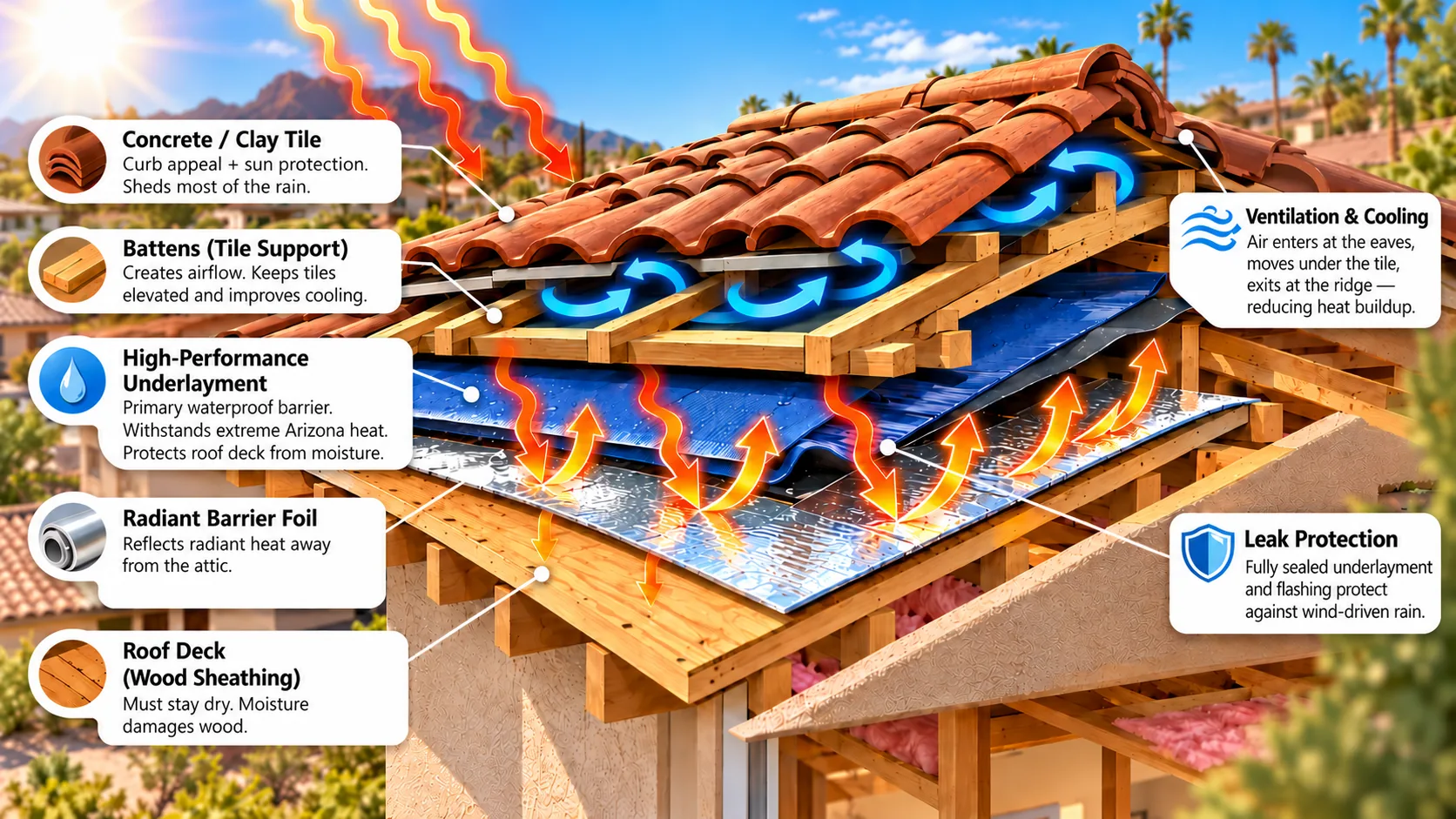
A cool tile roof is not simply a standard roof with foil placed underneath it.
The best-performing systems manage heat at several levels.
1. Solar-reflective roof covering
The outer roof surface determines how much solar energy is initially reflected or absorbed.
A tile should not be called “cool” based only on being tan, beige, or light-colored. The specific product and color should be checked for published solar-reflectance, thermal-emittance, SRI, or CRRC data where applicable.
Within one tile profile, different colors can have meaningfully different performance ratings.
2. Tile profile and thermal mass
Concrete and clay tile have mass and are installed as individual units rather than as one continuous thin surface.
The tile profile and installation method can create space beneath the roof covering, reducing direct heat transfer to the roof deck.
3. Reflective or radiant-barrier layer
A properly installed radiant barrier can reduce radiant heat transfer when its reflective surface faces an appropriate air space.
The placement and installation details matter as much as the foil itself.
4. Elevated battens
Elevated battens support tile while creating drainage and airflow paths beneath the roof covering.
Westlake describes its Elevated Batten System as a component that allows water to flow off the roof while helping ventilate and insulate the tile assembly.
5. Vented eave intake
Air must have a place to enter the roof assembly.
A vented eave can introduce outside air near the lower portion of the roof, supporting airflow beneath the tile.
6. Ridge or high-point exhaust
As air beneath the tile warms, it rises.
A vented ridge or properly designed high-point exhaust gives that warm air a path out of the system. Without a clear exit, intake ventilation alone cannot create the intended airflow.
7. High-temperature waterproofing
Energy efficiency cannot come at the expense of water protection.
The roof still needs an underlayment appropriate for Arizona heat, monsoon rain, roof penetrations, valleys, tile loading, and the installation method.
Westlake Royal TileSeal HT, for example, is a self-adhered SBS asphalt underlayment designed for sloped roof assemblies and tile applications. Its roofing-component literature identifies it as part of the manufacturer’s complete cool-roof system.
Factors Affecting Cool Roof Performance
Fourteen variables in four groups — the ones that move your bill most.
The following factors have the greatest effect on real-world savings, grouped by the roof system, the home and HVAC equipment, household behavior and rates, and installation quality.
Roof-system factors
Roof color and solar reflectance
Higher solar reflectance can reduce how much solar energy the roof absorbs. Verify the rating of the exact product and color being installed.
Thermal emittance
Exterior cool-roof surfaces benefit from releasing absorbed heat efficiently. Thermal emittance describes how effectively the surface radiates heat away.
Radiant-barrier placement
A low-emissivity reflective surface must face an appropriate air space to function as intended. Installation errors can reduce its value.
Cooler roof assemblies with reflective underlayment, per the manufacturer — when battens or a natural air space are present.
Source: RoofingFoil — a manufacturer claim, not a guaranteed attic-air temperature reduction.
Tile profile
High-barrel, medium-profile, and flat tile systems create different amounts of space beneath the tile and may produce different airflow characteristics.
Above-sheathing ventilation
Air movement between the tile and roof deck can help remove heat before it enters the attic.
Westlake’s tested cool-roof system combines tile, reflective underlayment, elevated battens, vented eaves, and ridge ventilation rather than relying on only one component.
Home and HVAC factors
Attic insulation
A heavily insulated ceiling already resists heat transfer. A cool roof may still help, but its effect on indoor temperature and electricity consumption may be less dramatic than in a poorly insulated home.
ENERGY STAR notes that cool roofs tend to save more energy in hot, sunny climates and in buildings with lower roof-insulation levels.
Ductwork location and leakage
Many Arizona homes have air-conditioning ducts in the attic.
If the attic is extremely hot, poorly insulated or leaking ducts can gain heat before cooled air reaches the rooms. Reducing attic heat exposure can help, but duct sealing may also be necessary.
SRP’s current duct-repair program specifically notes that savings vary based on duct leakage, home age, installation quality, and duct length.
HVAC age and efficiency
A newer variable-speed air conditioner will respond differently to reduced heat load than an older, oversized, undersized, or poorly maintained unit.
Roof orientation and shading
Large west- and south-facing roof areas receive intense afternoon solar exposure. Trees, neighboring structures, solar panels, and roof geometry can change how much sunlight reaches the roof.
Home size and ceiling design
A one-story home with a large attic footprint may respond differently from a two-story home with less roof area relative to conditioned floor space.
Vaulted ceilings, attic knee walls, bonus rooms, and duct chases also affect heat movement.
Household behavior and utility rates
Thermostat habits
A household maintaining 72°F throughout the summer will generally use more cooling energy than a household maintaining 78°F.
A more efficient roof can reduce the cooling load, but it does not eliminate the effects of thermostat choices.
Occupancy and internal heat
People, cooking, appliances, computers, lighting, and home-office equipment all add heat inside the home.
Utility rates
Even when energy use falls, rate increases can make the total bill appear flat or higher.
That is why energy performance should ideally be evaluated using both:
- Total dollars
- Total kilowatt-hours
Installation quality
Execution factor — applies to every component above.
A high-performance material installed poorly may underperform a more basic material installed as part of a well-designed system.
The details that carry the most risk: continuous airflow paths, sealed penetrations, and flashing.
All 9 installation details that decide whether the system performs
- Continuous airflow paths
- Correct eave and ridge ventilation
- Proper laps
- Sealed penetrations
- Valley design
- Batten layout
- Flashing
- Roof-deck preparation
- Compatibility among system components
How to Estimate Your Potential Cool Roof Savings
Five steps, starting with your own bills — then run the numbers below.
Before replacing your roof, collect the following information.
Review 12 to 24 months of bills
≈ 20 minutes
- Monthly kilowatt-hour use
- Monthly cost
- Rate plan
- Highest summer bills
- On-peak demand, where applicable
Using two years is helpful because one unusually mild or severe summer can distort the comparison.
Document the existing home
With your contractor
- Current tile
- Existing underlayment
- Attic insulation
- Duct condition
- Eave intake
- Ridge or roof exhaust
- Roof orientation
- Existing battens
- Roof-deck condition
Ask the roofing or energy professional to evaluate:
Request a component-by-component proposal
At proposal
- Tile manufacturer, profile, color, and rating
- Underlayment product
- Radiant-barrier product
- Required air-space configuration
- Batten system
- Intake ventilation
- Exhaust ventilation
- Flashing and waterproofing details
The proposal should identify exactly what creates the cool-roof benefit.
Do not accept “energy-efficient roof” as a complete specification. Ask for:
Ask for conservative and optimistic projections
At proposal
- 5% savings
- 10% savings
- 15% savings
- Any applicable manufacturer-tested system result
A useful proposal might compare:
Measure after installation
Year over year
- Weather
- Utility rates
- Occupancy
- Thermostat changes
- New appliances
- HVAC replacements
- Pool equipment
- Electric vehicles
Compare the same months year over year and adjust for:
Is a Cool Roof Worth It in Gilbert?
Nine conditions that favor it — and the cases where your money works harder elsewhere.
A cool roof is most financially attractive when:
- The roof already needs replacement
- The underlayment is already being replaced
- The home has a large attic footprint
- HVAC ducts are located in the attic
- The existing roof absorbs substantial heat
- The homeowner expects to remain in the property
- Summer electric bills are high
- The upgrade cost is reasonable relative to the base roof scope
- The system includes airflow and ventilation—not only a reflective product
The decision is less compelling when a perfectly functional roof would need to be replaced solely for energy savings or when the home’s primary problems are leaking ducts, failed HVAC equipment, or inadequate ceiling insulation.
The best approach is usually to coordinate the roof with the entire building envelope.
Each component has a job.
The Copper West Roofing Bottom Line
The model we recommend — and what a good roof actually buys you.
How much can you really save with an energy efficient cool roof in Gilbert?
For planning purposes, model your potential savings at 5%, 10%, and 15% of your annual electricity cost.
A Gilbert homeowner spending $5,550 per year would save approximately:
- $277.50 per year at 5%
- $555 per year at 10%
- $832.50 per year at 15%
Complete systems have produced higher results under specific test conditions, and at least one Copper West customer reported substantially greater initial monthly savings. Neither result should be treated as a universal guarantee.
The goal is not to promise a magical electric bill.
The goal is to build a roof that:
- Reflects more solar energy
- Reduces heat transfer
- Moves hot air out of the roof assembly
- Protects the home from water
- Performs under Arizona heat
- Gives the homeowner a realistic opportunity to reduce long-term cooling costs
Learn more about Copper West Roofing’s approach to Energy Efficient Cool Roofs in Gilbert.
Frequently Asked Questions
Short answers, with the same caveats as the article above.
How much can I save on my energy bill with a cool roof in Gilbert?
Savings vary by home and roof system. A practical way to estimate the benefit is to calculate 5%, 10%, and 15% of your annual electric bill.
For a home spending $5,550 per year, those scenarios equal approximately $278, $555, and $833 in annual savings.
Some manufacturers report higher savings for complete tested roof systems, but those figures should not be treated as guaranteed results for an individual home.
Want to run these numbers on your own bills? Download the Cool Roof Savings Worksheet (PDF, ungated).
What is the typical attic temperature drop with a radiant barrier?
There is no universal attic-temperature reduction.
The result depends on the radiant barrier’s location, air space, roof covering, ventilation, insulation, ductwork, weather, and measurement method.
Westlake Royal reports simulated attic temperatures of 139°F beneath a common asphalt-shingle installation and 94°F beneath concrete tile under identical test heat sources. RoofingFoil states that roofs using its reflective underlayment can be 20°F to 40°F cooler than comparable roofs without it. These are specific manufacturer examples—not guaranteed attic-air reductions for every Gilbert home.
Are there utility rebates for cool roofs in Gilbert?
As of July 2026, the current SRP and APS residential program pages reviewed for this article do not clearly list a general residential cool-roof rebate.
Both utilities offer other energy-saving programs, which may include incentives for insulation, HVAC equipment, duct improvements, smart thermostats, or demand-response participation.
Programs change, so homeowners should check directly with their utility before beginning work.
What factors impact cool roof performance and savings?
The most important factors include the tile’s solar-reflectance rating, roof orientation, tile profile, radiant-barrier installation, air space, battens, eave intake, ridge exhaust, attic insulation, duct leakage, HVAC efficiency, thermostat settings, occupancy, utility rates, and installation quality.
A complete roof system will generally provide a more reliable heat-management strategy than relying on one product alone.
roof projects completed across Gilbert and the East Valley, every one documented. Licensed, bonded and insured in Arizona — verify our license at azroc.gov.
Sources
- Westlake Royal Cool Roof Brochure — Backs: 22% tested-system result; 139°F/94°F simulated comparison; Elevated Batten System; TileSeal HT underlayment.
- RoofingFoil™ Underlayment — Backs: 20°F–40°F cooler-assembly manufacturer claim.
- SRP Residential Rebates — Backs: insulation, duct, and HVAC incentive amounts; time-based and demand price plans.
- APS Residential Rebates — Backs: Cool Rewards first-year incentive; 4–7 p.m. weekday on-peak hours.
- Cool Roof Rating Council Directory — Backs: product- and color-specific reflectance and emittance ratings.
Cool Roof Savings Worksheet
The five steps from this article as a fill-in worksheet: your bill baseline, your home’s documentation, a component-by-component proposal checklist, 5/10/15% projections, and a post-installation measurement log. Ask for a copy and we’ll send it over.
What would a 10% lower cooling bill be worth on your home?
Bring us 12 months of bills. We’ll walk your roof, spec the system component by component, and model conservative and optimistic scenarios on your actual numbers — before you’re asked to sign anything.